Aletheia (ἀλήθεια)
1- Player Assessments
Note: Click the image or text below the image to start the assessment




2- Player Assessments


Aletheia (ἀλήθεια) is the ancient Greek idea of truth as “unconcealment” what becomes visible when what’s hidden is brought into the light.
That’s the heart of these assessments: not “Are you a good person?” or “Do you think you’re emotionally intelligent?” but what do you reliably notice, understand, and do with emotion when it matters? Why Aletheia is worth taking (and why it works anywhere) Aletheia is designed as a hybrid, evidence-based EI assessment framework built to draw from the strongest strands of the scholarly field:
Ability EI: emotion as a set of mental abilities (perceiving, using, understanding, managing).
Emotion regulation science: how humans change emotion trajectories (before/during/after a reaction).
Trait EI: emotion-related self-perceptions that shape daily behavior (e.g., well-being, self-control, emotionality, sociability).
That blend matters because real life doesn’t grade you on intentions it grades you on outcomes: decisions, trust, conflict, performance under pressure, and repair after mistakes. The benefits (civilian, military, corporate, healthcare, education any environment) Aletheia helps because EI is consistently connected to workplace performance and effectiveness, especially where relationships and emotional labor are unavoidable. And it’s not a “fixed trait” story training and interventions show EI can improve with structured practice (moderate positive effects in meta-analyses; randomized studies show gains too).
So the payoff is practical:
Sharper judgment under stress (less hijack, more choice)
More influence with less force (people follow the person who can hold the emotional weather)
Stronger relationships and faster repair (conflict becomes information, not injury)
Greater resilience and cognitive flexibility (you don’t just survive setbacks you metabolize them)
Aletheia’s deeper gift is this: it names your default emotional reflexes and shows you where skill can replace reflex. It gives you a map of how your emotional system runs.
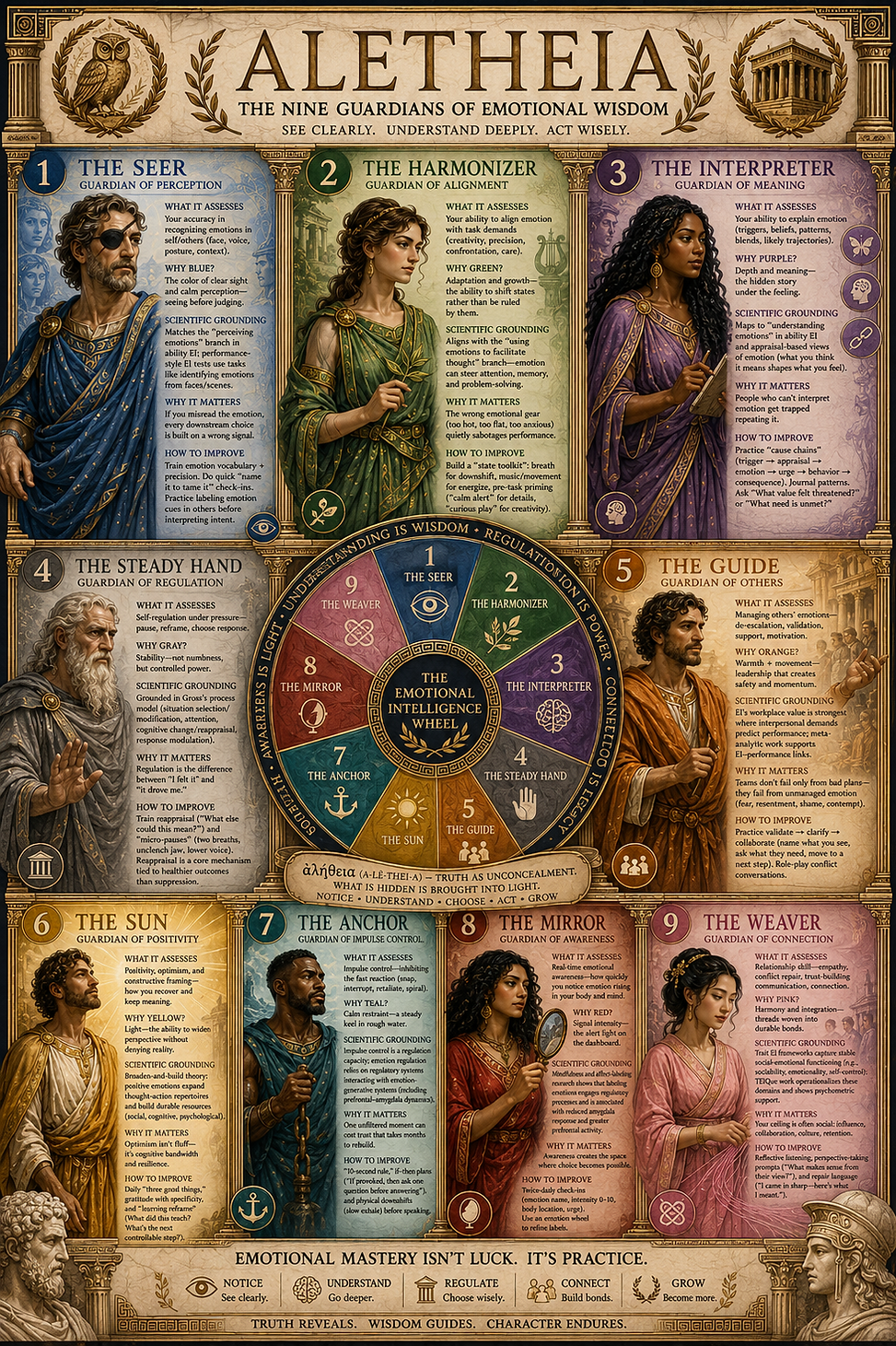
The Nine Guardians of Aletheia (numbered, colored, scientific, and usable)
1) The Seer — Blue
What it assesses: your accuracy in recognizing emotions in self/others (face, voice, posture, context).
Why blue: the color of clear sight and calm perception seeing before judging.
Scientific grounding: matches the “perceiving emotions” branch in ability EI; performance-style EI tests use tasks like identifying emotions from faces/scenes.
Why it matters: if you misread the emotion, every downstream choice is built on a wrong signal.
How to improve: train emotion vocabulary + precision (move beyond “fine/mad/stressed”); do quick “name it to tame it” check-ins; practice labeling emotion cues in others before interpreting intent.
2) The Harmonizer — Green
What it assesses: your ability to align emotion with task demands (creativity, precision, confrontation, care).
Why green: adaptation and growth the ability to shift states rather than be ruled by them.
Scientific grounding: aligns with the “using emotions to facilitate thought” branch—emotion can steer attention, memory, and problem-solving.
Why it matters: the wrong emotional gear (too hot, too flat, too anxious) quietly sabotages performance.
How to improve: build a “state toolkit”: breath for downshift, music/movement for energize, pre-task priming (“calm alert” for details, “curious play” for creativity).
3) The Interpreter — Purple
What it assesses: your ability to explain emotion (triggers, beliefs, patterns, blends, likely trajectories).
Why purple: depth and meaning the hidden story under the feeling.
Scientific grounding: maps to “understanding emotions” in ability EI and appraisal-based views of emotion (what you think it means shapes what you feel).
Why it matters: people who can’t interpret emotion get trapped repeating it.
How to improve: practice “cause chains” (trigger → appraisal → emotion → urge → behavior → consequence). Journal patterns; ask “What value felt threatened?” or “What need is unmet?”
4) The Steady Hand — Gray Done
What it assesses: self-regulation under pressure pause, reframe, choose response.
Why gray: stability not numbness, but controlled power.
Scientific grounding: grounded in Gross’s process model (situation selection/modification, attention, cognitive change/reappraisal, response modulation).
Why it matters: regulation is the difference between “I felt it” and “it drove me.”
How to improve: train reappraisal (“What else could this mean?”) and “micro-pauses” (two breaths, unclench jaw, lower voice). Reappraisal is a core mechanism tied to healthier outcomes than suppression.
5) The Guide — Orange
What it assesses: managing others’ emotions de-escalation, validation, support, motivation.
Why orange: warmth + movement leadership that creates safety and momentum.
Scientific grounding: EI’s workplace value is strongest where interpersonal demands predict performance; meta-analytic work supports EI–performance links.
Why it matters: teams don’t fail only from bad plans they fail from unmanaged emotion (fear, resentment, shame, contempt).
How to improve: practice validate → clarify → collaborate (name what you see, ask what they need, move to a next step). Role-play conflict conversations.
6) The Sun — Yellow
What it assesses: positivity, optimism, and constructive framing how you recover and keep meaning.
Why yellow: light—the ability to widen perspective without denying reality.
Scientific grounding: broaden-and-build theory: positive emotions expand thought-action repertoires and build durable resources (social, cognitive, psychological).
Why it matters: optimism isn’t fluff it’s cognitive bandwidth and resilience.
How to improve: daily “three good things,” gratitude with specificity, and “learning reframe” (What did this teach? What’s the next controllable step?).
7) The Anchor — Teal
What it assesses: impulse control inhibiting the fast reaction (snap, interrupt, retaliate, spiral).
Why teal: calm restraint a steady keel in rough water.
Scientific grounding: impulse control is a regulation capacity; emotion regulation relies on regulatory systems interacting with emotion-generative systems (including prefrontal–amygdala dynamics).
Why it matters: one unfiltered moment can cost trust that takes months to rebuild.
How to improve: “10-second rule,” if–then plans (“If provoked, then ask one question before answering”), and physical downshifts (slow exhale) before speaking.
8) The Mirror — Red
What it assesses: real-time emotional awareness how quickly you notice emotion rising in your body and mind.
Why red: signal intensity the alert light on the dashboard.
Scientific grounding: mindfulness and affect-labeling research shows that labeling emotions engages regulatory processes and is associated with reduced amygdala response and greater prefrontal activity.
Why it matters: awareness creates the space where choice becomes possible.
How to improve: twice-daily check-ins (emotion name, intensity 0–10, body location, urge). Use an emotion wheel to refine labels.
9) The Weaver — Pink
What it assesses: relationship skill empathy, conflict repair, trust-building communication, connection.
Why Pink: harmony and integration threads woven into durable bonds.
Scientific grounding: trait EI frameworks capture stable social-emotional functioning (e.g., sociability, emotionality, self-control); TEIQue work operationalizes these domains and shows psychometric support.
Why it matters: your ceiling is often social: influence, collaboration, culture, retention.
How to improve: reflective listening, perspective-taking prompts (“What makes sense from their view?”), and repair language (“I came in sharp here’s what I meant.”).
The scientific and poetic bottom line
Aletheia is an unmasking: It doesn’t just ask what you believe about yourself, it reveals how you perceive, interpret, regulate, and connect when the moment is real. The Nine Guardians are not nine “virtues.”
They are nine measurement lenses a way to find the exact link in your chain that’s strongest, and the one that quietly breaks first.